
Traveler’s Complete Guide · 2025
Chongqing Metro:
Your Underground Key to
the Mountain City
Navigate the world’s most dramatic metro system — through mountains, over rivers, across seventeen lines — without a single wrong turn.
In This Guide
Why the Metro is Your Best Friend in Chongqing
Chongqing is not a city that plays by ordinary rules. Built across mountains and river gorges, criss-crossed by the Yangtze and Jialing rivers, and draped perpetually in atmospheric mist, China’s largest municipality is one of the most spectacularly disorienting cities on Earth. Streets rise vertically. Highways thread through office buildings. Elevators replace staircases. And beneath — and sometimes above — it all runs one of the most impressive metro systems in the world.
As a foreign visitor, the Chongqing Rail Transit (重庆轨道交通, CRT) is not just convenient — it is genuinely the smartest, safest, and most economical way to explore a city where surface traffic is legendarily chaotic. For fares starting at just ¥2 (about $0.28 USD), you can zip from ancient alleyways to glittering riverside promenades, from fog-wrapped mountain viewpoints to the futuristic towers of the new CBD.
What makes Chongqing’s metro uniquely memorable for visitors is that it doesn’t hide underground like a conventional subway. Line 2’s elevated monorail glides straight through the sixth floor of the Liziba residential tower — a sight so surreal that tourists gather just to watch the train slip between living room windows. Stations perch on cliff faces. Platforms overlook the two great rivers. The metro here is not just transportation; it’s part of the spectacle.
This guide covers every major metro line useful to tourists, lists the key tourist attractions reachable by rail, explains the ticketing system in detail, and gives you the confidence to navigate this magnificent, maddening city like a local.
Line 1 — The City Spine
重庆轨道交通1号线 · East–West Backbone · 53 stations
Line 1 is the great artery of central Chongqing. Running broadly east to west, it connects the old peninsula district of Yuzhong — home to the historic city core — with the sprawling inland neighborhoods of Shapingba and Bishan. For most visitors, it will be the first line they ride and the one they return to most frequently. It is the metro line that anchors daily life in the city center.
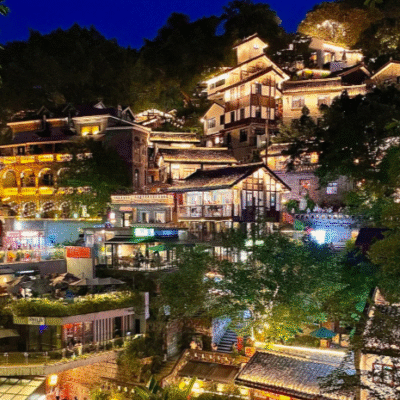
The line passes through Jiefangbei (解放碑), Chongqing’s Times Square equivalent — a dazzling pedestrianized commercial zone packed with shopping malls, street food stalls, and the famous Hongya Cave (洪崖洞) just minutes away on foot. Further along, it serves Shapingba, home to universities, bookshops, and the remarkable Ciqikou Ancient Town.
Traveler Tips — Line 1
- Jiefangbei station has multiple exits — follow signs to the Liberation Monument (解放碑) for the main pedestrian zone.
- From Xiaoshizi, Hongya Cave is an 8-minute walk downhill toward the Jialing River. The views from the lower levels at night are extraordinary.
- Ciqikou (Shapingba station) is best visited on weekday mornings to avoid weekend crowds. Arrive before 10am for the authentic market atmosphere.
Line 2 — The Sky Monorail
重庆轨道交通2号线 · The train that goes through buildings · 30+ stations
Line 2 is quite simply one of the most extraordinary urban rail rides in the world. This elevated monorail — yes, a monorail — clings to cliff faces, swoops over the Yangtze, and at one jaw-dropping point threads directly through the middle of the Liziba residential tower, its carriages sliding past apartments on the 6th, 7th, and 8th floors. Residents on those floors can look out their windows and watch a metro train pass at eye level. This single moment has become a global tourist phenomenon.
But Line 2 is far more than a curiosity. It is the primary connection between the central peninsula, the scenic Nanbin Road along the south bank of the Yangtze, and the mountains of the southern districts. It runs mostly elevated, offering remarkable views of the city’s topography throughout the journey.
Traveler Tips — Line 2
- For Liziba: ride through it first, then exit and walk to the viewing platform (观景台) on the road below. Watch 3–4 trains pass — each time is surreal.
- Sit on the right side of the train when traveling southward from the city center — the river views are on that side.
- Nanbin Road from Haitangxi station is most magical after 7pm when the opposite bank lights up. The walk takes about 30 minutes and passes dozens of excellent restaurants.
Line 3 — The Airport Express
重庆轨道交通3号线 · Jiangbei Airport to South City · 55 stations
Line 3 is likely the first metro line you will use in Chongqing — it runs directly to Jiangbei International Airport (T2 and T3 terminals), making it the standard arrival and departure route for international visitors. But it is far more than just an airport link. Line 3 is the longest line in the network, serving the north bank commercial districts, crossing the Yangtze via the spectacular Jiuqu River Bridge, and reaching the southern new districts.
The northern section of Line 3 passes through Chongqing North Railway Station (重庆北站), the city’s main high-speed rail hub — making it the crucial connection for those arriving from elsewhere in China by bullet train. The journey from the airport to the city center takes approximately 40–50 minutes and costs ¥7–10.
Traveler Tips — Line 3
- From Jiangbei Airport, Line 3 is clearly signposted in English in both terminals. Follow “Rail Transit” signs after baggage claim. Trains run until approximately 11:30pm.
- Buy your metro card (交通卡) at the airport station before entering the city — it will save time throughout your trip.
- For the city center, ride to Guanyinqiao or continue to transfer points for Lines 1 and 6.
Line 6 — The Mountain Express
重庆轨道交通6号线 · CBD to Northern Hub · 39 stations
Line 6 is the premium, high-frequency express line of the Chongqing metro — newer rolling stock, more frequent departures, and key stops at the city’s most significant landmarks. It runs from the Southern New Town through the heart of Jiefangbei, crosses to the north bank via tunnel, and heads north past landmark districts and Chongqing North Station.
For tourists, Line 6 is particularly significant because it serves Raffles City (来福士广场) — the soaring twin-tower complex whose glass sky bridge at 250 meters elevation offers arguably the most dramatic panoramic view of Chongqing’s river confluence — as well as the Zhongshuge Bookstore and the Danzishi Old Street neighborhood.
Traveler Tips — Line 6
- Chaotianmen station requires a 10-minute walk to reach Raffles City — follow signs toward the waterfront. The sky bridge ticket (¥120) is worth it for first-time visitors.
- The Yangtze River confluence view from Chaotianmen Square (ground level, free) is spectacular at dusk — arrive 30 minutes before sunset.
- Line 6 runs express sections during peak hours — double-check your boarding platform, as local and express trains use different stops on some sections.
Line 10 — The New Town Connector
重庆轨道交通10号线 · Airport to Jiangbei District · 15 stations
Line 10 is the newest major tourist-relevant line, providing a faster airport connection through the north bank business districts and linking Jiangbei Airport with key transfer hubs for onward metro journeys. It is especially useful for travelers headed from the airport directly to the Jiangbei district commercial area, who want to avoid a lengthy ride on the full Line 3 loop.
Traveler Tips — Line 10
- Line 10 provides the fastest airport link to the north bank — for travelers whose hotel is in Jiangbei or north Chongqing, this line saves 15–20 minutes vs Line 3.
- Transfer at Hongqiditch for Lines 1, 2, or 3 onward to the city center and south bank.
Other Lines Worth Knowing
Beyond the core lines above, Chongqing’s expanding network includes several other lines useful to visitors:
Complete Guide to Metro Tickets
Chongqing’s metro ticketing system is efficient, affordable, and — with a little preparation — completely navigable for foreign visitors, even those who do not read Chinese. Fares are calculated by distance, beginning at ¥2 for short journeys and capping at around ¥12 for the longest cross-city trips. By international standards, this is extraordinarily good value.
Ticket Types
Single-Journey Ticket
Chongqing Transport Card (交通卡)
WeChat Pay QR Code
Alipay Metro Code
Tourist Card (3-Day / 7-Day)
Children’s Fare
Fare Structure Explained
The standard fare formula in Chongqing: ¥2 for the first 4 kilometers, then ¥1 for each additional 4 kilometers, and ¥1 for each additional 5 kilometers beyond 24km. In practice, most tourist trips in the city center cost ¥2–4. Longer cross-city journeys (airport, distant districts) cost ¥6–10. The transport card automatically deducts the discounted fare upon exit.
| Journey Type | Typical Distance | Standard Fare | With Card (9.5% off) |
|---|---|---|---|
| Short hop (1–3 stops) | Under 4 km | ¥2.00 | ¥1.90 |
| Typical city center trip | 5–10 km | ¥3.00 | ¥2.85 |
| Cross-district journey | 15–20 km | ¥5.00 | ¥4.75 |
| Airport to city center | ~30 km | ¥7.00 | ¥6.65 |
| Maximum fare (any journey) | 50+ km | ¥12.00 | ¥11.40 |
Essential Practical Tips for Foreign Visitors
🕐 Operating Hours
Chongqing Metro runs from approximately 6:30am to 11:00pm daily, with slight variation by line and station. Last trains from terminal stations depart around 10:30pm. Check the CRT official app for exact last-train times on your specific route.
🌐 English Signage
All stations display bilingual Chinese/English signs, and all automated ticketing machines offer an English-language interface. Announcements on trains are made in Mandarin and English. Navigation is genuinely straightforward even without Chinese language ability.
🔒 Security Screening
All passengers must pass through airport-style X-ray screening at metro entrances. Have your bag ready to place on the belt. Passport or ID may occasionally be requested — carry your passport or a clear photo of it at all times.
📱 Navigation Apps
Baidu Maps and Amap (高德地图) both have English interfaces and provide excellent metro routing. Simply enter your destination in English and the apps show exactly which line, which direction, and how many stops. Apple Maps also works reasonably well in Chongqing.
🌡 Weather & Comfort
Metro carriages are heavily air-conditioned in summer (bring a light layer) and heated in winter. Chongqing’s famously humid heat makes the underground very welcome from June to September. Platforms can be crowded during rush hours (7:30–9am and 5:30–7:30pm).
🗺 Free Metro Maps
Physical metro maps in both Chinese and English are available free at all station service counters. The CRT official website and app also provide interactive maps. The network expands frequently — always check for the latest map on arrival.
🍜 Eating on the Metro
Food and drink are prohibited inside metro stations and carriages. Chongqing hotpot enthusiasts must wait until above ground! Most major stations have food stalls and restaurants in immediate proximity — the Jiefangbei area has hundreds of options within a 5-minute walk.
♿ Accessibility
All stations are equipped with elevators and escalators — important in a city of extreme elevation changes. Tactile paving guides visually impaired passengers throughout stations. Wheelchair accessible carriages are marked and available on all lines.
Metro-Powered Day Itineraries
These curated routes are designed to be completed entirely by metro, walking, and your own two feet — no taxis, no confusion, no language barrier at the door.
Classic Chongqing — The Peninsula & River Views
Best for: First-time visitors · Full day · Lines 1, 2, 6
Eling Station (Line 1) → Eling Park
Begin at Chongqing’s hilltop park — beautiful morning light, panoramic river views, and almost no tourists before 9am. The walk through bamboo-shaded paths is deeply atmospheric.
Liziba Station (Line 2) — Monorail Through the Building
Ride Line 2 through the legendary apartment-penetrating station, then exit and watch from the street-level viewing platform below. Allow time to watch 3–4 trains pass — each time is surreal.
Xiaoshizi Station (Line 1) → Hongya Cave Lunch
Walk down to the iconic Hongya Cave complex for lunch. Multiple floors of restaurants serving authentic Chongqing cuisine — small noodles (小面), stewed beef (卤牛肉), and of course the city’s legendary hotpot.
Chaotianmen Station (Line 6) → River Confluence & Raffles Sky Bridge
Take Line 6 two stops to Chaotianmen. Walk to the headland to watch where the two great rivers merge. Optional: buy Raffles City Sky Bridge tickets (¥120) for vertiginous views 250 meters above the water.
Haitangxi Station (Line 2) → Nanbin Road Sunset & Dinner
Cross to the south bank for the city’s most celebrated view — the entire illuminated Chongqing skyline reflected in the Yangtze. Walk the promenade, choose a riverside restaurant, and end the day with hotpot.
Historic Chongqing — Ancient Streets & Mountain Parks
Best for: History & culture lovers · Full day · Lines 1, 6
Shapingba Station (Line 1) → Ciqikou Ancient Town
Arrive early at this preserved river-port town from the Song Dynasty. Wander the alleyways before the crowds arrive, taste fresh sesame cakes from street vendors, and explore the Bao’en Temple.
Danzishi Station (Line 6) → Old Street & Yangtze Museum
Cross to the south bank for Danzishi Old Street — a neighborhood that has resisted gentrification more successfully than most. Local life, excellent street food, and the river just below.
Minzhu Road Station (Line 6) → Zhongshuge Bookstore
Visit the nationally renowned Zhongshuge Bookstore — a multi-story architectural marvel with dramatic sweeping staircases and an interior that has become one of China’s most photographed cultural spaces.
Jiefangbei Station (Line 1) → Evening at Liberation Monument
End at the iconic centerpiece of modern Chongqing — the Liberation Monument — as the sun goes down and the neon signs come on. The surrounding streets are at their most vibrant between 7–10pm.
Before You Go Underground
Chongqing rewards those who are willing to surrender to its logic — a city where vertical is the primary direction and the map is less useful than an instinct for elevation. The metro removes the hardest friction: the impossible streets, the bewildering topography, the language barrier at taxi windows. With a transport card, a navigation app, and this guide in hand, you have everything you need.
Do not be in a hurry. Take the elevated ride on Line 2 not just to arrive but to watch the city unfold outside the windows. Sit near the front of the monorail and look ahead as it curves around the cliff face. Stand on the platform at Chaotianmen and feel the scale of the two rivers below you. Chongqing’s metro is, in the end, a guided tour of one of the most extraordinary urban landscapes on the planet — and the ticket costs ¥2.